
Roadmap
Our Roadmap
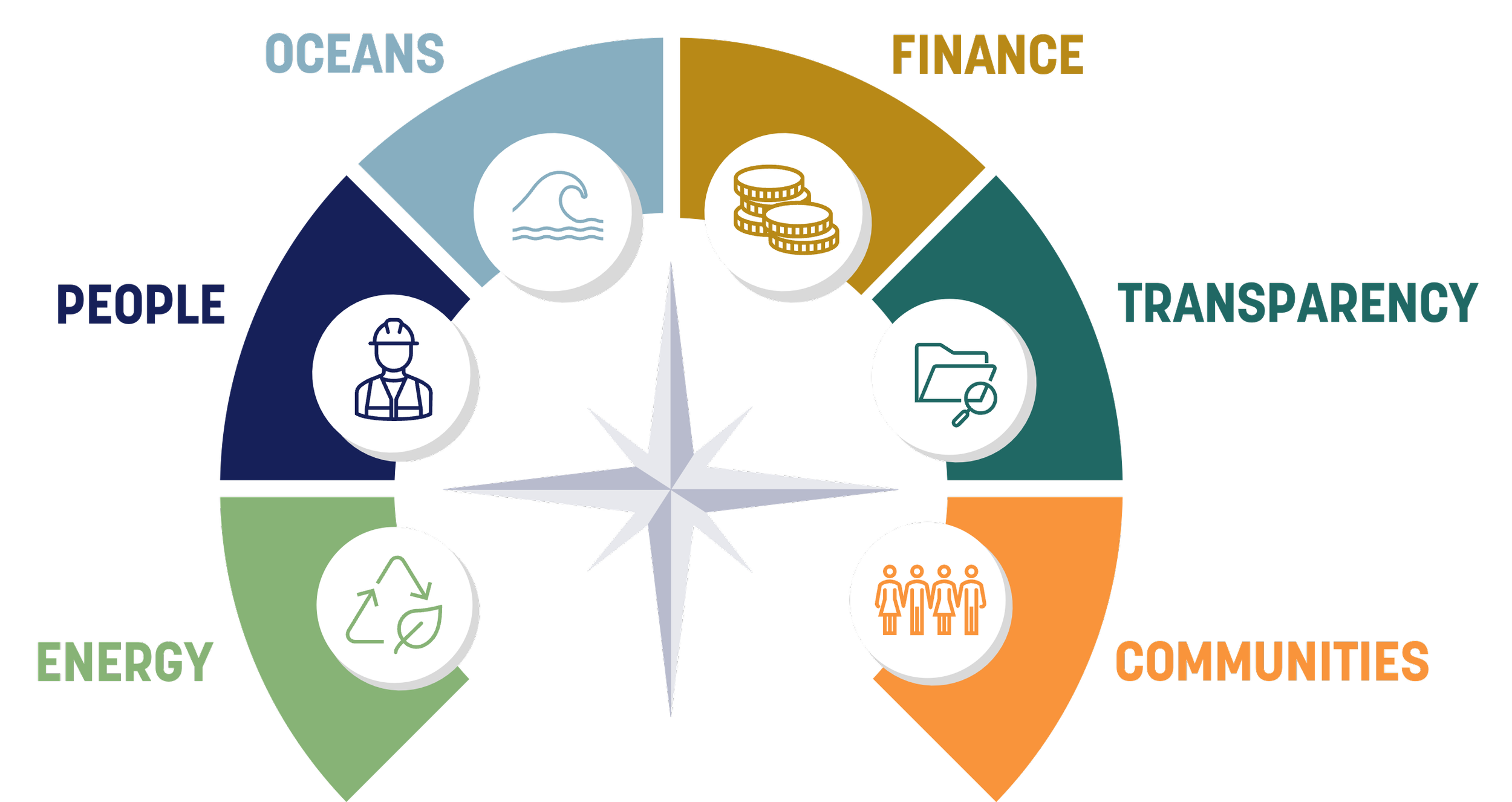
Developed by our members in partnership with wider industry, the Roadmap aims to consider all of the angles of sustainability in shipping. We envision a shipping industry that:
Contributes to responsible ocean governance use,
Acts as a trusted partner in communities,
Provides healthy, safe, secure and rewarding work,
Drives transparent and accountable decision making,
Develops financial solutions that reward sustainability, and
Adopts a range of zero carbon energy sources while avoiding negative environmental impacts.
ENERGY
Change to a diverse range of zero carbon energy sources, using resources more efficiently and responsibly for zero emission shipping and avoiding negative environmental and biodiversity impacts.
-
IMO Revised GHG Strategy operationalised through mid-term measures; absolute WtW emissions reduced in line with 2030 checkpoints; first zero-emission vessels enter service (2020s)
Disruptive fleet transition driven by global regulation; cost gap between fossil and ZNZ fuels closed; absolute WtW emissions aligned with 2040 checkpoints (2030s)
Majority of global fleet operates on ZNZ fuels; remaining fossil vessels are converted or retired (2040s)
International shipping operates at net-zero GHG emissions on a well-to-wake basis (2050s)
-
Operational efficiency is the main decarbonisation lever: speed optimisation, virtual arrival, wind assist, digital monitoring, charter-party alignment (2020s)
Automation and connected ships and ports make energy-efficient operation standard practice (2030s)
Resource-efficient operations and circular lifecycle principles embedded across the global fleet (2040s)
Energy demand stabilised and fully aligned with net-zero operation (2050s)
-
Dual-fuel new builds become standard; fuel lifecycle certification and book-and-claim frameworks established; pilot ZNZ supply chains scale (2020s)
ZNZ fuels available at scale and cost-competitive through global regulation and investment; ports develop ZNZ bunkering infrastructure (2030s)
Global fuel standards regulate lifecycle performance and safety; high-risk and non-aligned fuels phased out (2040s)
ZNZ fuel supply chains are mature, regulated and globally available (2050s)
PEOPLE
Provide safe, healthy and secure work environments so that people can enjoy rewarding careers and achieve their full potential.
-
International labour and human rights regulation related to onshore and offshore workers enters into force and is increasingly ratified (2020s)
Translation of international and human rights regulation into regional and national law(s) is achieved (2030s)
-
Industry best practice, codes of conduct and contractual terms addressing labour and human rights risks across the ship lifecycle developed (2020s)
Labour and human rights issues publicly disclosed and incorporated in contractual terms and decision making across the ship lifecycle (2030s)
-
Framework for reporting on fatalities and their causes developed to drive improvements in safe processes on ships, as well as in ship building, repair and recycling yards (2020s)
Reporting framework on fatalities and safety standards widely used across the industry (2030s)
-
Seafarers have access to high-quality training and career development support, including preparation for future impacts of autonomous ships (2020s)
Workers across all phases of the ship lifecycle, onboard and onshore, have access to union representation and their working and living standards are improved (2020s)
Globally recognised minimum competence qualifications and career development paths onboard and onshore are adopted and implemented (2030s)
Companies actively enforce internal policies aligned with IMO minimum standards, eliminating discrimination, harassment and bullying, whilst safeguarding whistle blowers (2030s)
Onboard shipping careers rank equally with shore-based industries in terms of attractiveness and job satisfaction, career development, and impact on mental health and well-being (2040s)
-
Best practices in diversity, equality and inclusivity shared and implemented for a maritime workforce where all workers are treated with respect and fairness (2020s)
Equal access and entry to the shipping industry, regardless of age, disability, ethnicity, gender identity, race, and sexual orientation (2030s)
OCEANS
Contribute to responsible ocean governance and the healthy use of marine resources.
-
Progressive increase in adoption of sustainable ocean policy and blue economy principles, and development of a roadmap to improve global ocean governance (2020s)
Shipping-related ocean governance is strengthened, with improved coordination on ocean impacts and issues and ramped-up enforcement of laws and regulations (2030s)
Tools, resources and audits for marine spatial planning used regionally and nationally (2040s)
Well-enforced marine spatial planning and marine protected areas (2050s)
-
Best practices and technologies that reduce underwater noise, avoid marine mammal interactions and minimise pollutant discharge are developed and increasingly adopted (2030s)
Routing, operational practices and area-based measures are regularly reviewed and updated to minimise ecological disturbance (2040s)
Near-zero-impact technologies and operational practices used across the global fleet (2050s)
-
Tools, resources and audits for marine spatial planning developed, with research and pilot projects sharing good practice (2020s)
Standardised tools and resources for MSP are used nationally and regionally and good practice is shared (2030s)
MSP frameworks evolve using new ecological data and updated scientific guidance (2040s)
A system of well-enforced MSP and marine protected areas supports a healthy ocean (2050s)
FINANCE
Develop financial solutions that reward sustainable performance and enable large scale uptake of innovation, technology, design & operational efficiencies.
-
Financial stakeholders incentivise transparency and public reporting on environmental, social and governance (ESG) performance, factoring this into purchasing decisions including new ship purchases and retrofits (2020s)
Sustainable shipping finance tools addressing ESG performance including sustainability-linked loans and green bonds are developed and implemented, facilitating R&D and technology investments (2020s)
Sustainability performance targets and comprehensive ESG reporting become the industry norm and are systematically factored into financing decisions (2030s)
Sustainable shipping finance tools are mainstreamed across the shipping sector, linking sustainability and financial performance (2030s)
Sustainability performance targets are developed and updated on a rolling basis in line with global climate ambitions (2040s)
-
Natural capital disclosure framework including natural capital accounting and reporting is adopted and mainstreamed across the industry (2020s)
Pilot methodologies developed to demonstrate the monetary value of goods and services generated by marine ecosystems (2020s)
Nature-related financial information widely available and used in shipping finance decision making (2030s)
Global methodology for ecosystem valuation adopted and factored into marine spatial planning negotiations and decision making (2030s)
TRANSPARENCY
Drive performance improvements and enable better, sustainable decision making through transparency and accountability.
-
Industry and regulators apply strong financial, legal and regulatory pressure for shipowners to report on sustainability performance (2020s)
Transparency and traceability throughout the ship lifecycle increase the rate of reuse and recycling of a ship’s equipment and components (2020s)
Globally agreed minimum sustainability performance indicators and data published and widely used for business decisions (2030s)
Ship designers, builders and recyclers, equipment manufacturers and other shipping services compete on the basis of facilitating high sustainability performance (2030s)
-
Fully transparent sustainability rating schemes are available for shipowners covering issues throughout the ship lifecycle (2020s)
Cargo owners, shipping finance and insurance companies actively use sustainability rating schemes covering issues throughout the ship lifecycle to make decisions (2030s)
-
Technological innovations are used to optimise supply chain sustainability, transparency and accountability (2020s)
Supply chain transparency across the ship lifecycle demanded by customers and factored into decision making processes (2030s)
-
Sustainability performance data is measured against agreed international standards and publicly disclosed (2020s)
Sustainability performance data is audited, validated and made publicly available (2030s)
COMMUNITIES
Be a trusted and responsible partner in the communities where we live, work and operate.
-
Standards for the planning, design and development of new port facilities are developed in consultation with local communities (2020s)
Ports and coastal communities are represented in national and global port governance (2030s)
-
Transparency and reporting mechanisms for ports, on sustainability performance, are developed and implemented (2030s)
-
Impacts of shipping on port, coastal and indigenous communities along shipping routes are mapped to develop solutions and ensure shipping traffic does not negatively impact communities, natural habitats and wildlife (2020s)
Corruption and piracy are eliminated through collaboration with communities (2030s)
-
Sustainable and clean ports programs aimed at improving air and water quality are developed through an expanding global coalition of ports (2020s)
Sustainable and clean ports programs are widely implemented and minimum standards for ports developed to reduce fatalities due to poor air quality (2030s)
-
A circular economy ecosystem approach is increasingly adopted by ports, shipyards and port communities, linking all phases of the ship lifecycle, from ship design, building, operation to end of life including ship recycling (2020s)
Port and shipyard infrastructure is built in line with circularity principles, facilitating the repair, reuse and recycling of ships and ship components (2030s)